The data behind the design: How Pantone built agentic AI with an AI-ready database
Discover an innovative AI-based experience launched as a minimum viable product aimed at collecting genuine user feedback and enabling quick iterations.
When discussing agentic AI, we often get lost in abstract topics like models and prompts. However, the most engaging examples I’ve encountered show how AI taps into our human traits—creativity, intuition, and expertise—at unprecedented speed and scale.
That’s why I was thrilled to host Color Meets Code: Pantone’s Agentic AI Journey on Azure, a webinar featuring Pantone leaders Kristijan Risteski, a solutions architect, and Rohani Jotshi, a senior director of engineering. During the session, Kris and Rohani revealed how they’re leveraging agentic AI to enhance a vital aspect of design: colour, with support from an AI-ready database, Azure Cosmos DB, which is key to this undertaking.
The challenge: Expanding colour expertise in a fast-paced interactive world
Pantone is globally celebrated as a colour authority. For many years, their skilled teams have merged artistic insight, colour science, and trend predictions to aid designers and brands in defining and managing colour across various fields—ranging from fashion and product design to packaging and digital interfaces.
However, as discussed in the webinar, transforming that extensive expertise into a modern conversational AI tool posed significant challenges. Crafting colour palettes is both time-intensive and crucial to the design process. Designers often flit between different tools, colour selectors, and trend reports before finally settling on a usable palette.
Pantone identified a chance to completely transform this workflow: What if designers could engage with decades of research, trend insights, and colour psychology through a chat-based interface, instantly generating curated colour palettes?
Introducing the Palette Generator: Your agentic AI experience
The outcome is Pantone’s Palette Generator, an AI-driven tool released as a minimum viable product aimed at gathering genuine user feedback and refining quickly. Instead of providing static suggestions, the Palette Generator employs a multiagent setup that responds dynamically to user intent, conversation context, and historical data.
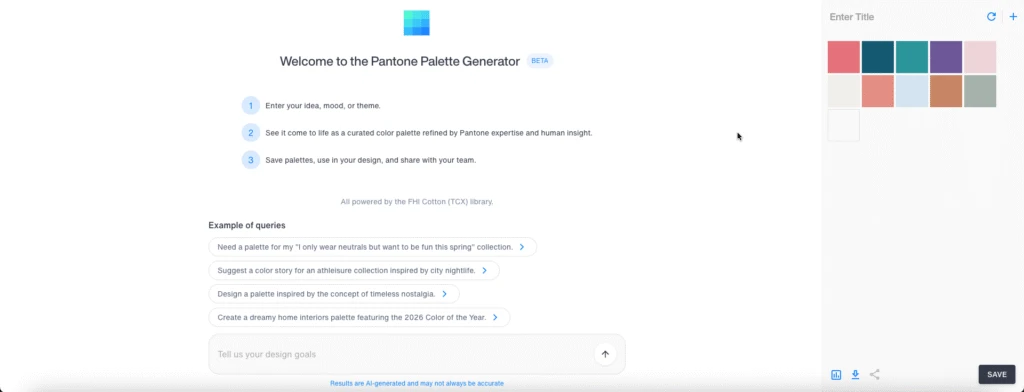
During the webinar, the Pantone team explained how they set up the system with specialised agents—including a “chief colour scientist” and a palette-generating agent—each tasked with different responsibilities like reasoning, context retrieval, and response formulation. Together, these agents deliver curated colour combinations that leverage Pantone’s unique data and knowledge.
What really impressed me was not only the advanced nature of the AI but the meticulous design behind it. Agentic AI isn’t solely about principles; it’s fundamentally about data.
Why Azure Cosmos DB is a cornerstone
At the core of Pantone’s Palette Generator is Azure Cosmos DB, functioning as the system’s real-time data layer. It’s utilized to store and manage chat histories, prompt data, message collections, and insights into user interactions—all critical for agents that are responsive and aware of context.
While researching the best storage solution, we examined various databases. What stood out with Azure Cosmos DB was its seamless integration into our systems. We managed to establish our initial proof of concept with just a few lines of code, retrieving data incredibly fast—in mere milliseconds.
Kristijan Risteski
Azure Cosmos DB was selected for its scalability, enabling Pantone to effectively serve users globally with quick data access.
This is crucial. As applications evolve from “doing” tasks to “understanding” them, databases must go beyond handling simple transactions. They need to manage vast volumes of operational data, adapt to evolving AI workflows, and support advanced scenarios like conversational memory, analytics, and vector-based searches.
Pantone’s architecture exemplifies what it means to be “AI-ready.” Azure Cosmos DB offers the necessary scalability and flexibility to trace user prompts and interactions across sessions, coupled with analytics that help Pantone grasp customer interactions with the Palette Generator over time.
Transitioning from text to vectors—and what’s ahead
Another key takeaway Pantone shared during the webinar was how their architecture is evolving to enhance relevance, accuracy, and contextual comprehension. While their current system already enables rich conversational interactions, the team discussed future enhancements that involve transitioning from text-based storage to vector-based workflows. This shift will include embedding user prompts and contextual information, facilitating vector searches, and enriching responses with greater semantic depth.
Azure Cosmos DB plays a role in this as well, supporting vectorized data, integrating with agent orchestration, and embedding models deployed via Microsoft Foundry. This enables Pantone to adapt swiftly without needing to overhaul the entire system—an essential quality in today’s fast-evolving AI landscape.
Tangible outcomes from an agentic architecture
Pantone didn’t merely discuss their vision—they provided actionable outcomes from actual use of the Palette Generator. According to data from the webinar, users in over 140 countries engaged with the tool, generating thousands of unique interactions within the first month of launch and conversing in numerous languages. The system noted steady queries per user session, indicating designers were actively experimenting, refining prompts, and exploring ideas through conversation.
Equally significant, Pantone highlighted how swiftly they’ve been able to learn and adapt. Understanding prompt sensitivity, user behaviours, and making architectural trade-offs regarding speed, cost, and reliability has all influenced ongoing improvements. The flexibility of Azure Cosmos DB made it feasible to capture these insights and evolve the experience without hampering innovation.
What can be learned for anyone developing agentic AI
Pantone’s journey emphasises several key lessons frequently encountered by customers building AI agents on Azure:
- Data drives agentic AI. Without a real-time, scalable database, even the most sophisticated models can fall short in delivering consistent, contextually aware experiences.
- Feedback loops are essential. By capturing prompts, responses, and user interactions within Azure Cosmos DB, Pantone can keep improving both the AI and the overall product experience.
- Flexibility is crucial. AI architectures change rapidly—from orchestration patterns to embedding strategies—and databases need to evolve accordingly.
What Pantone has achieved with the Palette Generator transcends being just a feature; it serves as a blueprint for how organisations can translate profound domain knowledge into intelligent, agent-driven applications. By integrating Microsoft Foundry, Azure AI services, and an AI-optimised database like Azure Cosmos DB, Pantone demonstrates how creativity and technology can advance side by side.
As more organisations adopt agentic AI, the pressing question won’t be whether they can deploy models but whether their data structures are prepared to support real-time understanding, memory, and scalability. Pantone’s path clearly illustrates: AI-ready applications begin with AI-ready data.
Share this content: