From insight to action: The next phase of agentic cloud operations
Imagine if your cloud environment could seamlessly transition from insight to action in real-time, with systems already anticipating the next moves. Sounds ideal, doesn’t it?
As applications grow across hybrid infrastructures, microservices, and AI workloads, top organisations are shifting towards models where insights flow directly into action in a continuous, system-driven cycle.
This is where agentic cloud operations come into play. This approach employs AI-powered agents that, guided by user intent, continually observe, reason, and assist with actions throughout the cloud lifecycle. Rather than seeing signals as isolated events, they become part of coordinated workflows that evolve, enhancing performance, cost-effectiveness, and reliability as systems operate.
Recent findings from Material indicate that 79% of organisations are already using agentic AI in production, highlighting how rapidly this model is being adopted in cloud operations.
Governance Links Insight to Action
For this model to work effectively, governance must be woven directly into cloud operations. Observability offers a constant stream of signals and context, yet these signals only become useful when they can prompt action in a systematic and reliable manner. As agents assume greater responsibilities for detection, investigation, and resolution, every move should adhere to policies defined by humans, respect access controls, and align with the organisation’s goals.
At the recent Microsoft Build event, this necessity was highlighted. Developers and IT professionals require governance integrated into the same workflows that bridge observability and optimisation. When insights prompt actions, those actions must remain bounded, auditable, and reproducible across different environments.
Our vision for agentic operations encompasses a unified operating model that merges observability and optimisation. Here, insights lead directly to actions governed by inherent policies, ensuring humans remain part of the loop. In Azure, we are crafting a system where observability, governance, and optimisation work harmoniously. Signals are continuously assessed, actions are taken within policy guidelines, and outcomes feed back into the system to inform future decisions.
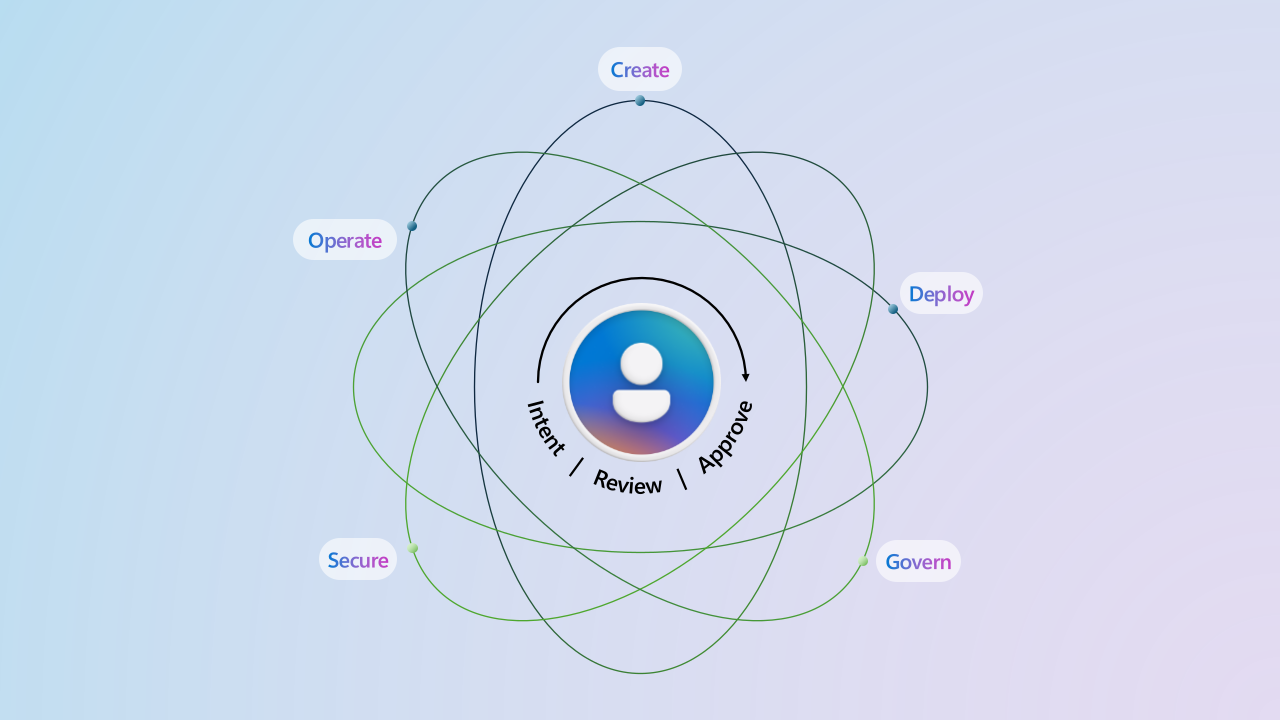
Observability Acts as the Intelligence Layer
As cloud environments grow, manual processes struggle to keep pace with telemetry and alerts. Engineers often find themselves sifting through signals, verifying problems, and grasping recent changes.
In an agentic model, observability provides ongoing intelligence. It equips AI agents with the context they require to pinpoint significant signals, comprehend dependencies across their environment, and highlight relevant insights early. Essentially, observability clarifies what’s happening and why, in a timely manner.
Transitioning from Signals to Resolution
Building on this base, the Azure Copilot observability agent is now generally available, bringing this intelligence into daily operations. This observability agent can continually assess telemetry across your environment, including application structure, dependencies, and standard behaviours. When an issue arises, it can pinpoint patterns, initiate an investigation, and offer context before teams begin their analysis.
With agentic observability, incident management becomes more effective. Problems can be identified earlier, with related signals grouped to limit distractions. Investigations may initiate automatically, tracing dependencies across services to help pinpoint likely root causes. Teams receive clear, contextual recommendations that facilitate quicker decision-making.
Furthermore, observability encompasses AI workloads, allowing for a comprehensive view of agents, services, and infrastructure together. This setup fosters a more consistent flow from detection to understanding to action, requiring less manual intervention along the way.
The most significant advantage is speed… The observability agent has enabled us to resolve issues faster and decrease operational overhead… we’ve effectively saved around 250 engineering hours each month.
—Narmada Krishnaswamy, Head of KPMG Audit Application Support and Operations
Observability provides a clearer picture of ongoing events while laying the groundwork for the next steps. It answers a critical question in cloud operations: what’s happening and why? However, for organisations operating at a large scale, this is just the beginning.
Continuous Optimisation
When observability delivers consistent, real-time context, it can steer continuous improvement.
Microsoft defines optimisation as the ongoing enhancement of cloud workloads regarding cost, performance, resilience, and sustainability. Within an agentic model, optimisation is not an isolated, periodic task but becomes ingrained in daily workflows.
During the FinOps X 2026 event, various organisations noted that AI is creating new cost dynamics. Usage patterns are increasingly unpredictable and often linked to rapid workload fluctuations. This unpredictability makes traditional cost management methods less reliable. Thus, optimisation should be integrated closely with decision-making processes.
From Dashboards to Integrated Workflows
As optimisation becomes more unified, work processes also evolve. Teams can move away from toggling between different tools and dashboards. Instead, they can engage with systems through guided workflows. Agents assist in estimating costs before resources are provisioned, automatically apply governance measures, monitor usage patterns, and highlight potential issues sooner.
For instance, during the development phase, cost implications can be highlighted prior to deployment, alongside relevant policy advice. As systems operate, usage patterns can be scrutinised, and modifications explored with necessary context. When improvement opportunities arise, agents can assist in prioritising and guiding the next steps. Such an approach integrates cost, performance, and efficiency considerations throughout the workflow more consistently.
To support this model, Microsoft is extending cost and usage intelligence beyond the Azure portal to the tools that teams already use.
The Azure Resource Manager MCP Server, currently in public preview, allows AI agents to access cost and usage data through a standard interface. This helps cost insights integrate into developer environments, copilots, and bespoke workflows without needing custom adaptations.
Consequently, developers can become more cognizant of cost implications while operations teams can analyse and optimise through natural language interactions. Workflows can be more uniformly applied across teams and environments.
Complex processes such as estimation, investigation, and optimisation can also be structured into reusable workflows, enabling teams to enhance these practices as they scale.
Integrating Everything in a Closed-Loop System
Observability and optimisation are becoming closely linked. Observability delivers continuous context, while agentic AI interprets signals and facilitates actions. Optimisation reflects the results of these actions over time, guided by governance and policy. This framework creates a system where insights can smoothly inform subsequent steps and every action contributes to ongoing advancements. In the long run, this promotes more consistent operations across various environments and teams.
In this setup, progress is achieved through informed actions and enhanced consistency. Microsoft aids organisations in adopting this method by linking people, data, and tools via Azure Copilot and associated capabilities. Teams gain the advantage of addressing issues more effectively, leveraging continuous optimisation, and operating with intrinsic governance.
Get Started with Azure
To witness how these features work together in practice, take the opportunity to explore and test them within your environment:
Share this content:
Discover more from Qureshi
Subscribe to get the latest posts sent to your email.
