Introducing Microsoft Agent Framework
The Microsoft Agent Framework is now in public preview, along with exciting Azure AI Foundry updates that help developers create, monitor, and manage multi-agent systems more easily.
Today, we’re thrilled to share new Azure AI Foundry features that make it easier for developers to build, monitor, and govern multi-agent systems while helping businesses bridge the trust gap in AI.
As the adoption of agent-based AI grows—according to PwC, eight out of ten enterprises now employ some form of agentic AI—the complexities of managing these systems are increasing too. Developers often face fragmented tools, and companies struggle to ensure that agents act responsibly. Our recent updates to Azure AI Foundry directly address these issues.
Introducing Microsoft Agent Framework (public preview)
The Microsoft Agent Framework is now in public preview, an open-source SDK and runtime that streamlines multi-agent orchestration. It combines AutoGen, a previous Microsoft Research venture, with the robust foundations of Semantic Kernel to create a unified framework—bringing cutting-edge research to developers’ fingertips.
With the Microsoft Agent Framework, developers can:
- Experiment locally before deploying to Azure AI Foundry, which includes observability, durability, and compliance features.
- Connect any API via OpenAPI, collaborate across runtimes with Agent2Agent (A2A), and dynamically link to tools using the Model Context Protocol (MCP).
- Utilise the latest multi-agent patterns like Magentic One and orchestrate agents into streamlined workflows.
- Minimise context switching between tools and platforms to improve efficiency.
- Create multi-agent systems that connect Azure AI Foundry, Microsoft 365 Copilot, and other agent frameworks.
This framework helps developers stay in the zone. An industry study shows that 50% of developers lose more than 10 hours each week due to inefficiencies like fragmented tools, underscoring the demand for solutions that simplify the developer journey.
One organisation leveraging the Microsoft Agent Framework to reduce challenges is KPMG. KPMG’s transformation started with KPMG Clara, its cloud-based smart audit platform used in audits worldwide.
KPMG Clara AI is closely aligned with the next-gen, open-source Microsoft Agent Framework, which integrates Semantic Kernel and AutoGen.
This means KPMG Clara AI can connect specialised agents to enterprise data and tools while benefiting from built-in safeguards and an open, extensible ecosystem for developers. The framework’s open-source connectors let KPMG Clara AI agents work not only with Azure AI Foundry but also with external systems and language models, enabling multi-agent collaboration across a global, regulated enterprise.
The Foundry Agent Service and Microsoft Agent Framework connect our agents to data and to each other, while the governance and observability in Azure AI Foundry give KPMG firms what they need to thrive in a regulated industry.
— Sebastian Stöckle, Global Head of Audit Innovation and AI at KPMG International
We welcome developers to help shape the future of agentic AI by sharing code and feedback on the Microsoft Agent Framework.
Multi-agent workflows (private preview)
Building on the Microsoft Agent Framework, we are enhancing these capabilities directly in the cloud with multi-agent workflows in Foundry Agent Service. This innovative feature lets developers orchestrate complex, multi-step business processes with a structured, stateful workflow layer.
With multi-agent workflows, teams can:
- Coordinate multiple agents over long-term tasks, with persistent states and shared context.
- Automate complex enterprise scenarios such as customer onboarding, financial transactions, and supply chain automation.
- Use built-in error handling, retries, and recovery to enhance reliability at scale.
Design and debug workflows visually via the VS Code Extension or Azure AI Foundry, then deploy, test, and manage them alongside existing solutions in Foundry.
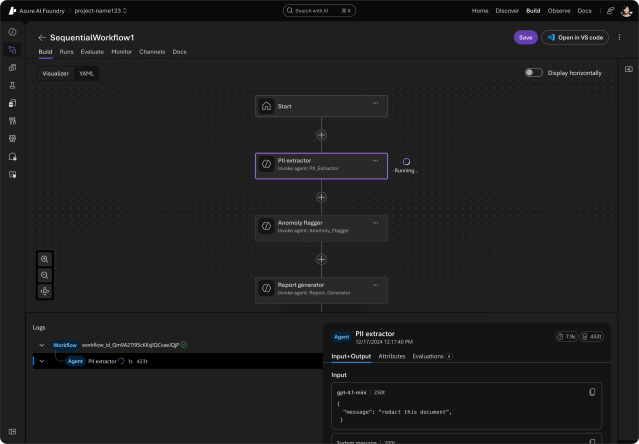
Many customers are actively exploring this capability, and we are eager to extend it to more users in the upcoming weeks.
Multi-agent observability across popular frameworks with OpenTelemetry contributions
We’re excited to announce improvements to multi-agent observability, with contributions to OpenTelemetry designed to standardise tracing and telemetry for agentic systems.
This enhancement gives teams deeper insight into agent workflows, tool-call executions, and collaborations—essential for debugging, optimisation, and compliance. Microsoft developed these OpenTelemetry updates in partnership with Outshift, Cisco’s incubation engine.
Thanks to these improvements, Azure AI Foundry now offers unified observability for agents built using various frameworks, including Microsoft Agent Framework and others like LangChain, LangGraph, and OpenAI Agents SDK.
Voice Live API in Azure AI Foundry is now generally available
Multi-agent workflows are increasingly initiated and concluded through voice commands. We are excited to announce the general availability of the Voice Live API, which lets developers and businesses create scalable, production-ready voice AI agents. The Voice Live API provides a seamless, real-time speech-to-speech interface that combines speech-to-text (STT), generative AI models, text-to-speech (TTS), avatar, and conversational enhancement features into one efficient, low-latency pipeline.
Companies like Capgemini, healow, Astra Tech, and Agora are using the Voice Live API to build customer service agents, educational tutors, HR assistants, and multilingual agents. Voice Live API is redefining how developers build voice AI solutions, offering an integrated, efficient path to success.
Responsible AI capabilities public preview
With advancements in agent observability and framework integration, ensuring that AI systems function responsibly and securely is just as crucial—especially as they become ingrained in vital enterprise processes.
According to McKinsey’s 2025 Global AI Trust Survey3, the main obstacle to AI adoption is the lack of governance and risk-management tools. Thus, we are preparing to release the following responsible AI features in public preview in the coming weeks:
These capabilities are integrated into Azure AI Foundry, helping organisations build confidently and meet both internal and external standards.
Customer momentum
Azure AI Foundry solutions are helping over 70,000 organisations globally—from digital natives to established enterprises—turn AI innovation into tangible outcomes. For instance:
Commerzbank: Commerzbank is testing the Microsoft Agent Framework to enable avatar-driven customer support, enabling more natural, compliant customer interactions.
The new Microsoft Agent Framework simplifies coding, reduces effort, and fully supports MCP for agentic solutions. We are excited to see how container-based Azure AI Foundry agents can significantly lessen the workload in IT operations.
— Gerald Ertl, Managing Director/Head of Digital Banking Solutions, Commerzbank AG
Citrix: Citrix is exploring how to implement agentic AI within virtual desktop infrastructure (VDI) environments to boost enterprise productivity and efficiency.
Citrix has always championed flexible work as a leading provider of secure work solutions. As we enter a realm where agentic AI collaborates alongside us, we’re keen to enable this within our customers’ everyday workspaces. Microsoft’s Agent Framework offers a modern, developer-centric approach to crafting agents. With support for key APIs and languages, and seamless adoption of emerging protocols for tool interaction and observability, it fosters intuitive agent development on Azure AI Foundry without sacrificing developer control. We fervently expect to use the framework to fulfil our vision of enterprise-scale, production-ready AI agents for our customers.
— George Tsolis, Distinguished Engineer, Citrix
TCS: Tata Consultancy Services is developing a multi-agent strategy within the Microsoft Agent Framework, with initiatives across finance, IT operations, and retail demonstrating strategic and technical investment.
Adopting the Microsoft Agent Framework represents more than just a technological advance; it is a bold move towards reshaping industry value chains. By harnessing Agentic AI and Frontier models, we empower our teams to create flexible, scalable, enterprise-grade solutions that transform workflows and add value across platforms. True leadership involves empowering innovation, embracing changes, and creating an environment where agility and collaboration foster excellence.
— Girish Phadke, Head, Microsoft Azure Practice, TCS
Sitecore: Sitecore is crafting a solution that enables marketers to interact seamlessly with the platform by automating tasks across the entire content supply chain—from creating and managing web experiences to handling digital assets—using intelligent agents.
By partnering with Microsoft to leverage its innovative Microsoft Agent Framework, Sitecore can unite the advantages of fully non-deterministic agentic orchestration with the dependability of executing more deterministic, repeatable agents. Simultaneously, we gain from Microsoft’s enterprise-grade observability and telemetry, ensuring these orchestrations are not only powerful but also secure, measurable, and production-ready.
— Mo Cherif, VP of AI, Sitecore
Elastic: Elasticsearch is now equipped with a native connector to Microsoft Agent Framework, allowing developers to effortlessly integrate enterprise data into intelligent agents and workflows.
Elasticsearch is the go-to platform for organizations to store and search their most valuable operational and business data. With the new Microsoft Agent Framework connector, developers can easily bring the most relevant organizational context into intelligent agents and multi-agent workflows. This simplicity makes it easier than ever to create production-ready AI solutions, combining the reasoning capabilities of agents with the speed and scalability of Elasticsearch.
— Steve Kearns, General Manager Search Solutions, Elastic
A trusted agent factory for developers
Azure AI Foundry is not just a platform—it’s a trusted agent factory for developers and enterprises. Whether you’re a CIO aiming to scale AI responsibly, a security architect focused on governance, or a developer building the next evolution of intelligent agents, Azure AI Foundry provides essential tools, frameworks, and trust.
Microsoft shines in the AI realm thanks to its dedication to open standards, interoperability, and responsible AI. The Microsoft Agent Framework, currently in public preview, provides a cohesive, enterprise-grade framework that integrates cutting-edge research, enabling developers to orchestrate multi-agent systems effortlessly while ensuring observability, durability, and compliance.
Unlike other offerings, our framework supports integration with any OpenAPI-enabled API, enables runtime collaboration through Agent2Agent (A2A), and allows dynamic tool connections via MCP. This design minimises context-switching, helping developers stay productive and advance innovation.
The framework’s open-source nature encourages developers to contribute and shape the future of agentic AI, making it a collaborative, forward-thinking platform. With Microsoft at the helm, organisations can trust that their AI systems will be powerful, efficient, responsible, and secure, addressing major barriers to AI adoption as highlighted in McKinsey’s 2025 Global AI Trust Survey.
2 AI adoption is flourishing, yet challenges remain.
3 Insights into responsible AI from the Global AI Trust Maturity Survey.
Share this content:
Discover more from Qureshi
Subscribe to get the latest posts sent to your email.
